After a few self indulgent posts of what n2cqr would call "travelogue", its time to post some more useful material about Dayton - particularly as I'd made a fool of myself by speaking at the Four Days in May event...
Those of you who showed the good taste to miss my presentation can at least download the materials from this site.
There is a copy of the written "paper", which was printed in the conference "proceedings".
There is also a copy of the PowerPoint slides I used as backdrop to my presentation - although many of the animations and transitions will make precious little sense without my words over the top - the slides are just the "backing track". That's not to suggest they made much sense with my words over the top!
The presentation was recorded on video and will be made available on-line at some point. I'll add a link to make my embarrassment complete when such a link becomes available.
For any that don't know, QRP-ARCI's "Four Days in May" runs concurrently with the Dayton Hamvention.
Both events are a must-see for QRP enthusiasts, in my opinion. The social side of FDIM is particularly enjoyable.
I believe these are coffee mats - but they may as well have been beer mats, as there was quite a deal of business conducted in the bar!
The Hamvention - which is based on the other side of town, some thirty minutes' drive away from the FDIM Hotel, is vast.
The indoor spaces include trade stalls from ALL the major manufacturers and all the important groups and Societies, such as our own RSGB...
Mrs m0xpd was even running the G-QRP stall single-handed at one stage!
As well as the big players, smaller manufacturers are present too, including American Morse Equipment, from whom I purchased the little paddle kit mentioned in a previous post...
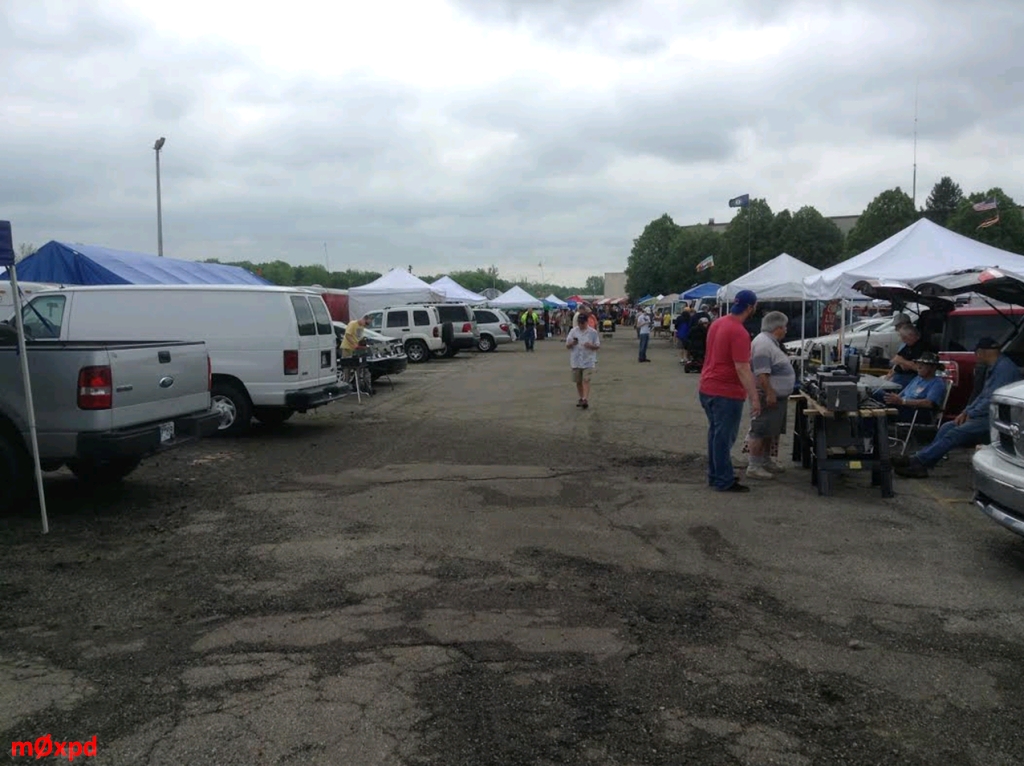
When you're done with the indoor stalls, you can go outside to the Flea Market - where you need to be prepared with all the American superlatives ("Awesome" etc) you can muster - for it extends further than the eye can see (and much further than my legs or my patience could carry me).
Here's a shot of one random line of parked-up dealers, plying their trade...
Whilst I appreciate that not everybody is able to get there (it is expensive and inconvenient) FDIM gets my very highest recommendation. I had a great time.
My special thanks to Steve, g4gxl, to all my friends at G-QRP, to Rex, w1rex, to Tom, wb8lcd and Chuck, w8pt and to all the other folks I enjoyed meeting and talking with.
I shall certainly be there next year!
...-.- de m0xpd
Friday, 5 June 2015
Wednesday, 3 June 2015
Ham Radio in Laramie
I arrived back home yesterday from my trip to the US, my jeg-lagged mind awash with memories of new friends and great experiences. I met a great bunch of amateurs in my old stomping ground in Laramie, WY...
First, I met a few hams at my talk at the University, where I spoke about the Physical Computing movement and its implications in STEM outreach, Teaching and Learning, and Curriculum Design.
Bob, n7cii, is a faculty member and it was great to meet and chat with him - particularly as it turned out he had my old office and had graced it with a copy of EMRFD!
Walt, k7se, also came along to the talk - he was to become a good friend throughout my visit, being honoured at the "Bernie Club" BBQ, which Lou, wy7ls, President of the University Amateur Radio Club, had arranged in Washington Park.
Several local hams gathered for burgers, hot dogs, chicken, etc and a good chat...
Seems that "Bernie" (from which these gatherings take their name) was a ham from the nearby Colorado town (no doubt the locals would call it a city - any U.S. setlement of more than three or four inabitants is a "city") of Fort Collins.
I had a great evening, learning that the dominant activity of the club is in provision of VHF communication services for community events (such as bicycle races), which, as well as being a useful and enjoyable activity in itself, provides a framework for the provision of a similar service, should it be needed in emergency or extreme weather conditions.
Walt was celebrating 60 years of "radio activity" during my visit, so a cake was produced, cut and enjoyed - you see Walt, his wife Dolores, ka7mpb and the cake below...
Also seen in the photo above is Scott, who remembers me from the time I was a young Faculty member at UW back in the 1980s - seems I was his advisor when he was a transfer student. I apologised and said I hoped I hadn't blighted his life too badly. We were able to enjoy pleasant time together - so it seems my sins were forgiven.
I was lucky enough to be invited out to Walt's place N of town, where he has a great shack, optimised for his passions of DX-ing and contesting (apologies for the poor "phone" photo)...
His 30 acres on the prairie allow antenna farming on the scale I can only dream of - and you can see the clear blue skies of Wyoming at a mile and a quarter altitude that I still do dream of...
Walt gave me a leaving gift of surpassing generosity, which must be recorded...
I met a great bunch of hams - but I'd like to thank another ham who I didn't meet. Both before and during my visit, Dale, wc7s, down in Cheyenne, had provided a bunch of information and inspiration about radio in the Rocky Mountain West and and WY in particular. Thanks Dale - maybe next time!
If ever you're fortunate enough to be in the West, get in touch with these guys and gals.
...-.- de w7/m0xpd
First, I met a few hams at my talk at the University, where I spoke about the Physical Computing movement and its implications in STEM outreach, Teaching and Learning, and Curriculum Design.
Bob, n7cii, is a faculty member and it was great to meet and chat with him - particularly as it turned out he had my old office and had graced it with a copy of EMRFD!
Walt, k7se, also came along to the talk - he was to become a good friend throughout my visit, being honoured at the "Bernie Club" BBQ, which Lou, wy7ls, President of the University Amateur Radio Club, had arranged in Washington Park.
Several local hams gathered for burgers, hot dogs, chicken, etc and a good chat...
Seems that "Bernie" (from which these gatherings take their name) was a ham from the nearby Colorado town (no doubt the locals would call it a city - any U.S. setlement of more than three or four inabitants is a "city") of Fort Collins.
I had a great evening, learning that the dominant activity of the club is in provision of VHF communication services for community events (such as bicycle races), which, as well as being a useful and enjoyable activity in itself, provides a framework for the provision of a similar service, should it be needed in emergency or extreme weather conditions.
Walt was celebrating 60 years of "radio activity" during my visit, so a cake was produced, cut and enjoyed - you see Walt, his wife Dolores, ka7mpb and the cake below...
Also seen in the photo above is Scott, who remembers me from the time I was a young Faculty member at UW back in the 1980s - seems I was his advisor when he was a transfer student. I apologised and said I hoped I hadn't blighted his life too badly. We were able to enjoy pleasant time together - so it seems my sins were forgiven.
I was lucky enough to be invited out to Walt's place N of town, where he has a great shack, optimised for his passions of DX-ing and contesting (apologies for the poor "phone" photo)...
His 30 acres on the prairie allow antenna farming on the scale I can only dream of - and you can see the clear blue skies of Wyoming at a mile and a quarter altitude that I still do dream of...
Walt gave me a leaving gift of surpassing generosity, which must be recorded...
I met a great bunch of hams - but I'd like to thank another ham who I didn't meet. Both before and during my visit, Dale, wc7s, down in Cheyenne, had provided a bunch of information and inspiration about radio in the Rocky Mountain West and and WY in particular. Thanks Dale - maybe next time!
If ever you're fortunate enough to be in the West, get in touch with these guys and gals.
...-.- de w7/m0xpd
Thursday, 21 May 2015
Contact
I gave up on trying to find a telescopic pole and - instead - got some racquet balls and a ball of twine.
The ball is like a squash ball (only bigger) and I've tied the end of the twine to it, so I can pitch it over the limb of a tree and hoist up the "holiday dipole" that way.
Here's the entire travelling station, laid out on a bench...
You can see the twine and the ball at top left, a co-ax feeder (which I purchased at vendor evening at FDIM) and the antenna wrapped around the covers of a ring binder (a real convenient method of transporting it, which I will post about later) and the rest of the kit, including the new American Morse paddle (from the Hamvention) on the right hand side.
Here's your humble servant operating from the same bench, which is on the North bank of Lewis and Clark Lake, South Dakota...
I had a nice QSO with Art, k8cit, over in Michigan, who gave me 449 - it works!
...-.- de w0/m0xpd
The ball is like a squash ball (only bigger) and I've tied the end of the twine to it, so I can pitch it over the limb of a tree and hoist up the "holiday dipole" that way.
Here's the entire travelling station, laid out on a bench...
You can see the twine and the ball at top left, a co-ax feeder (which I purchased at vendor evening at FDIM) and the antenna wrapped around the covers of a ring binder (a real convenient method of transporting it, which I will post about later) and the rest of the kit, including the new American Morse paddle (from the Hamvention) on the right hand side.
Here's your humble servant operating from the same bench, which is on the North bank of Lewis and Clark Lake, South Dakota...
I had a nice QSO with Art, k8cit, over in Michigan, who gave me 449 - it works!
...-.- de w0/m0xpd
Tuesday, 19 May 2015
Heading West
After a great time at Four Days in May, Shack Nasties is heading west...
We're heading out on Interstate 80 (as you see) inspired by both the Oregon Trail and by Jack Kerouac. I say "we" because the XYL seems to have joined the team in a very positive way at both FDIM and the Hamvention - she's much more than a passenger and companion now!
Talking of Jack Kerouac, I couldn't help buying this bag at the University Bookstore in Iowa City today...
Iowa City is a handsome place and the State University is built around the beautiful old State Capitol building.
I was lucky to get a nice Hendricks TriBander CW rig at FDIM (thanks Dennis) and I purchased a little paddle from Doug, w6ame, at American Morse, to partner it. But I can't find anybody to sell me a telescopic pole ( a "crappie pole") to lift the middle of the new holiday dipole and do some Stateside operating.
I 80 goes all the way to Laramie, but we'll be turning off North to take in some other sights in South Dakota before we reach our old hometown on Sunday.
Wagons roll!
... -.- de w0/m0xpd
Wagons roll!
... -.- de w0/m0xpd
Thursday, 14 May 2015
Parallel IF Code
The Parallel IF idea is getting an airing at QRP-ARCI's Four Days in May convention this week.
The Vero demonstrator has accompanied me across the pond and will be available for scrutiny at FDIM (and for demonstration, if we can cobble together an antenna and catch any signals)...
To celebrate and support the event, I've released a copy of the Parallel IF code, which is available at my Github repository. It is the same code as that running on the demo system above.
It is underpinned by the Si5351 device. Whilst my original Parallel IF rig used (and still uses) a pair of DDS modules, I'm not going to release any code for these AD9850 RF generators, believing the Si5351 to be the better choice for this application.
The core of the technique involves the establishment of a 2*2 MATRIX of local oscillator frequencies, where before there was just a two element vector...
One row of the matrix, indicated by a red box in the graphic above, is associated with each of the IF paths. In my case, there is a 10 MHz path, used for sideband applications and a 12 MHz path, used for CW applications. The particular frequencies in the matrix are associated with MY home-brewed IF filters. If you use the code, you'll need to change these frequency constants to suit YOUR filters!
The two columns of the matrix, indicated by the blue boxes in the graphic above, are associated with lower and upper sideband operation, respectively.
The code between the appropriate row, depending upon the user's choice of receiving bandwidth and the appropriate column, depending upon the band, to set the local oscillator (/BFO).
My presentation at FDIM presents the contrast in receiving response achieved by selection of one of the two parallel IF paths using a rather childish analogy with the width of an open door - the tight CW band presenting a narrow opening and the sideband channel giving a wider opportunity to pass the signal...
As ever, bug reports, comments etc., gratefully received!
...-.- de m0xpd
The Vero demonstrator has accompanied me across the pond and will be available for scrutiny at FDIM (and for demonstration, if we can cobble together an antenna and catch any signals)...
To celebrate and support the event, I've released a copy of the Parallel IF code, which is available at my Github repository. It is the same code as that running on the demo system above.
It is underpinned by the Si5351 device. Whilst my original Parallel IF rig used (and still uses) a pair of DDS modules, I'm not going to release any code for these AD9850 RF generators, believing the Si5351 to be the better choice for this application.
The core of the technique involves the establishment of a 2*2 MATRIX of local oscillator frequencies, where before there was just a two element vector...
One row of the matrix, indicated by a red box in the graphic above, is associated with each of the IF paths. In my case, there is a 10 MHz path, used for sideband applications and a 12 MHz path, used for CW applications. The particular frequencies in the matrix are associated with MY home-brewed IF filters. If you use the code, you'll need to change these frequency constants to suit YOUR filters!
The two columns of the matrix, indicated by the blue boxes in the graphic above, are associated with lower and upper sideband operation, respectively.
The code between the appropriate row, depending upon the user's choice of receiving bandwidth and the appropriate column, depending upon the band, to set the local oscillator (/BFO).
My presentation at FDIM presents the contrast in receiving response achieved by selection of one of the two parallel IF paths using a rather childish analogy with the width of an open door - the tight CW band presenting a narrow opening and the sideband channel giving a wider opportunity to pass the signal...
As ever, bug reports, comments etc., gratefully received!
...-.- de m0xpd
Friday, 8 May 2015
Another Rig for Occam...
The new Si5351 shield, shortly to be launched on an unsuspecting public at FDIM, and the new Rx shield, which made its debut only a few weeks ago at Blackpool, have tempted me to put together a new rig.
Following on with the idea of inflating Occam's famous razor (pun intended) up to the rather more dangerous proportions of a Dagger, I have taken the further liberty of fueling the arms race by suggesting that our pacific Franciscan should have a bigger weapon yet...
But what's bigger than a dagger?
How about a Dirk...
I want to reserve the obvious "Occam's Sword" name for a rather bigger rig (yet to be built) - but this is something of an upgrade from the earlier "Occam's Dagger" rig, so I had to find a half-way house and "Occam's Dirk" just about covers it.
The new rig uses the new production Si5351 board (an application I have already explored) and the new Rx board. But I wanted to include - for the first time - switchable multi-band operation in an Occam's rig (having only had plug-in band-pass filters in Occam's Dagger and a hard-wired low-pass, which made it really a single band rig). So, I set about making some simple switchable filters...
These were not to be the complicated, four-band, I2C-controlled devices of the "Parallel IF" rig. Rather, they are the smallest step-up from a single filter - namely, a double filter!
I designed the band-pass board around some double-pole change-over switches I gt in a job-lot from Jabdog at some rally many moons ago. Here's a finished board, populated for 40m (switch out) and 20m (switch in)...
Having hit on a useful format for the band-pass filter, I decided to make a matching low-pass - seen below...
The idea is that the filter boards stack, in such a way that the switches are next to each other - press them both (and operate the menu change in the software) to change bands.
Here are the filter boards stacked...
The new filter stack, coupled with the stack of...
make up the hardware of Occam's new Dirk...
As you see, it is still a plate of noodles spilling onto the bench (in truth, it is spilling onto the top of a nearby Leslie 825, the bench already being full). Perhaps one day it will get a case.
The potentiometer between the LCD and the tuning knob is a volume control, as described in the Rx Shield notes.
You can download the code for "Occam's Dirk" from here and try it for yourself.
This new spin on the original Occam's Microcontroller rig is great fun - it validates the use of the Si5351 in this application and it has been putting out a nice signal - both from the main station g5rv and from the new "mobile" dipole - all over Europe, on both its bands.
...-.- de m0xpd
Following on with the idea of inflating Occam's famous razor (pun intended) up to the rather more dangerous proportions of a Dagger, I have taken the further liberty of fueling the arms race by suggesting that our pacific Franciscan should have a bigger weapon yet...
But what's bigger than a dagger?
How about a Dirk...
I want to reserve the obvious "Occam's Sword" name for a rather bigger rig (yet to be built) - but this is something of an upgrade from the earlier "Occam's Dagger" rig, so I had to find a half-way house and "Occam's Dirk" just about covers it.
The new rig uses the new production Si5351 board (an application I have already explored) and the new Rx board. But I wanted to include - for the first time - switchable multi-band operation in an Occam's rig (having only had plug-in band-pass filters in Occam's Dagger and a hard-wired low-pass, which made it really a single band rig). So, I set about making some simple switchable filters...
These were not to be the complicated, four-band, I2C-controlled devices of the "Parallel IF" rig. Rather, they are the smallest step-up from a single filter - namely, a double filter!
I designed the band-pass board around some double-pole change-over switches I gt in a job-lot from Jabdog at some rally many moons ago. Here's a finished board, populated for 40m (switch out) and 20m (switch in)...
The idea is that the filter boards stack, in such a way that the switches are next to each other - press them both (and operate the menu change in the software) to change bands.
Here are the filter boards stacked...
The new filter stack, coupled with the stack of...
make up the hardware of Occam's new Dirk...
As you see, it is still a plate of noodles spilling onto the bench (in truth, it is spilling onto the top of a nearby Leslie 825, the bench already being full). Perhaps one day it will get a case.
The potentiometer between the LCD and the tuning knob is a volume control, as described in the Rx Shield notes.
You can download the code for "Occam's Dirk" from here and try it for yourself.
This new spin on the original Occam's Microcontroller rig is great fun - it validates the use of the Si5351 in this application and it has been putting out a nice signal - both from the main station g5rv and from the new "mobile" dipole - all over Europe, on both its bands.
...-.- de m0xpd
Sunday, 3 May 2015
Excess Aerial Baggage
Having turned over another page on the calendar and frightened myself by seeing the word "May", there's no avoiding the fact that I soon need to pack my bags and wend my weary way to Dayton.
I see with a mixture of surprise and amusement that I've been billed as "The Man from Laramie" (on QRP-L)...
I'll give James Stewart a run for his money!
Particularly fitting as my trip to Dayton is the first leg of a longer trip to my old hometown of - you guessed it - Laramie, WY.
Those bags I need to pack are going to be pretty stuffed - not least because the XYL is coming along on the trip too and she has her ornithological paraphernalia - as well as the proverbial kitchen sink.
I've decided I need to take an HF antenna - partly to demonstrate the Parallel IF receiver which I'll be talking about and partly because I might be doing some operating (I'm getting a new rig - more about that when I get back). But what antenna to take?
I'm not exactly big on mobile operating - so my mobile antenna choices are limited. There's the Walkabout that I've used on marine mobile exploits and damaged on the beach. Then there's my "holiday dipole", which actually is the very first HF antenna I ever had here at the home station - so it is a rather clumsy QRO affair, hardly suitable for sticking in a suitcase...
I decided to make a new antenna, more in keeping with the "mobile" label. It would be - in the first instance, 40m only. Perhaps in the fullness of time and given a rush of blood to the head I might add traps for 20m but - for now - 40m only.
I looked in the junk boxes and found some BN-34-301 bino cores that looked as if they offer the right balance between sufficiently small size for porterage and sufficiently large size to handle a few Watts to make a viable 1:1 balun for a QRP antenna, which I set about making according to the following scheme...
The schematic above is well-configured for seeing how the balun should be wired up, but not especially helpful for developing any sense of how it actually works - specifically how it achieves the necessary 1:1 impedance ratio (as compared to the familiar and simpler 1:4 balun which can be made with only two windings).
So, here's a re-arranged version of the schematic in a form which (I think) carries a little more teaching...
Note carefully the phasing of the coils (indicated by the dots) without which it will not work!
Here's the balun, realised in a little potting box...
I've arranged for some thick monofilament nylon to take the strain at the dipole centre (rather than the conductor itself) and the feeder is connected by a BNC, as you can see. This would be useless in a permanent installation due to moisture ingress - but this isn't a permanent installation!
I set the length of the dipole elements by matching them to the original "holiday dipole" and gave the new antenna a quick check with the FT 817 - it showed a nice low SWR across the 40m band.
Some hot-melt to stop the bino core wagging around and the box top to tidy things up had the new dream catcher finished...
It is, as you see by comparing the centimetre grid on which it is standing, rather more appropriately sized for portability than the old QRO antenna it replaces.
That's one more thing I can cross off the list of things to do before setting off for the New World,
...-.- de m0xpd, aka the Man from Laramie !
The weather being a little more cooperative again, I took the new antenna out into the back garden and hoisted it into an inverted vee - flying the centre from a telescopic fishing pole. Had chance to check not only that it returned "a nice low SWR" - but also that I could radiate a decent signal from it, courtesy of spots on the Reverse Beacon Network from all over the place and a QSO with Steve, g0evj.
I was using my FT 817 and a new version of the Occam's Dagger rig, which I'll tell you about when I get chance for a longer post...
I see with a mixture of surprise and amusement that I've been billed as "The Man from Laramie" (on QRP-L)...
I'll give James Stewart a run for his money!
Particularly fitting as my trip to Dayton is the first leg of a longer trip to my old hometown of - you guessed it - Laramie, WY.
Those bags I need to pack are going to be pretty stuffed - not least because the XYL is coming along on the trip too and she has her ornithological paraphernalia - as well as the proverbial kitchen sink.
I've decided I need to take an HF antenna - partly to demonstrate the Parallel IF receiver which I'll be talking about and partly because I might be doing some operating (I'm getting a new rig - more about that when I get back). But what antenna to take?
I'm not exactly big on mobile operating - so my mobile antenna choices are limited. There's the Walkabout that I've used on marine mobile exploits and damaged on the beach. Then there's my "holiday dipole", which actually is the very first HF antenna I ever had here at the home station - so it is a rather clumsy QRO affair, hardly suitable for sticking in a suitcase...
I decided to make a new antenna, more in keeping with the "mobile" label. It would be - in the first instance, 40m only. Perhaps in the fullness of time and given a rush of blood to the head I might add traps for 20m but - for now - 40m only.
I looked in the junk boxes and found some BN-34-301 bino cores that looked as if they offer the right balance between sufficiently small size for porterage and sufficiently large size to handle a few Watts to make a viable 1:1 balun for a QRP antenna, which I set about making according to the following scheme...
The schematic above is well-configured for seeing how the balun should be wired up, but not especially helpful for developing any sense of how it actually works - specifically how it achieves the necessary 1:1 impedance ratio (as compared to the familiar and simpler 1:4 balun which can be made with only two windings).
So, here's a re-arranged version of the schematic in a form which (I think) carries a little more teaching...
Note carefully the phasing of the coils (indicated by the dots) without which it will not work!
Here's the balun, realised in a little potting box...
I've arranged for some thick monofilament nylon to take the strain at the dipole centre (rather than the conductor itself) and the feeder is connected by a BNC, as you can see. This would be useless in a permanent installation due to moisture ingress - but this isn't a permanent installation!
I set the length of the dipole elements by matching them to the original "holiday dipole" and gave the new antenna a quick check with the FT 817 - it showed a nice low SWR across the 40m band.
Some hot-melt to stop the bino core wagging around and the box top to tidy things up had the new dream catcher finished...
It is, as you see by comparing the centimetre grid on which it is standing, rather more appropriately sized for portability than the old QRO antenna it replaces.
That's one more thing I can cross off the list of things to do before setting off for the New World,
...-.- de m0xpd, aka the Man from Laramie !
Update (4 May)
The weather being a little more cooperative again, I took the new antenna out into the back garden and hoisted it into an inverted vee - flying the centre from a telescopic fishing pole. Had chance to check not only that it returned "a nice low SWR" - but also that I could radiate a decent signal from it, courtesy of spots on the Reverse Beacon Network from all over the place and a QSO with Steve, g0evj.
I was using my FT 817 and a new version of the Occam's Dagger rig, which I'll tell you about when I get chance for a longer post...
Subscribe to:
Posts (Atom)